SAT reading test
[start-test type=8]
[start-block]
[timer duration="65:00"]
Reading Test
65 MINUTES, 52 QUESTIONS
Turn to Section 1 of your answer sheet to answer the questions in this section.
DIRECTIONS
Each passage or pair of passages below is followed by a number of questions. After reading each passage or pair, choose the best answer to each question based on what is stated or implied in the passage or passages and in any accompanying graphics (such as a table orgraph).
Questions 1-10 are based on the following passage.
This passage is adapted from Kevin Drum, “America’s Real Criminal Element: Lead” ©2013 Mother Jones.
Experts often suggest that crime resembles an epidemic. But what kind? Economics line professor Karl Smith has a good rule of thumb for categorising epidemics: If it spreads along lines of communication, he says, the cause is information. Think Bieber Fever - enthusiasm for the music and person of Justin Bieber! If it travels along major transportation routes, the cause is microbial. Think influenza. If it spreads out like a fan, the cause is an insect. Think malaria. But if it's everywhere, all at once—as both the rise of crime in the '60s and '70s and the fall of crime in the '90s seemed to be—the cause is a molecule.
A molecule? That sounds crazy. What molecule could be responsible for a steep and sudden decline in violent crime? Well, here's one possibility: Pb(CH 2 CH 3 ) 4 .
In 1994, Rick Nevin was a consultant working for the US Department of Housing and Urban Development on the costs and benefits of removing lead paint from old houses. A growing body of research had linked lead exposure in small children with a whole raft of complications later in life, including lower IQ, hyperactivity, behavioural problems, and learning disabilities.
(I) A recent study had also suggested a link between childhood lead exposure and juvenile delinquency later on. Maybe reducing lead exposure had an effect on violent crime too?
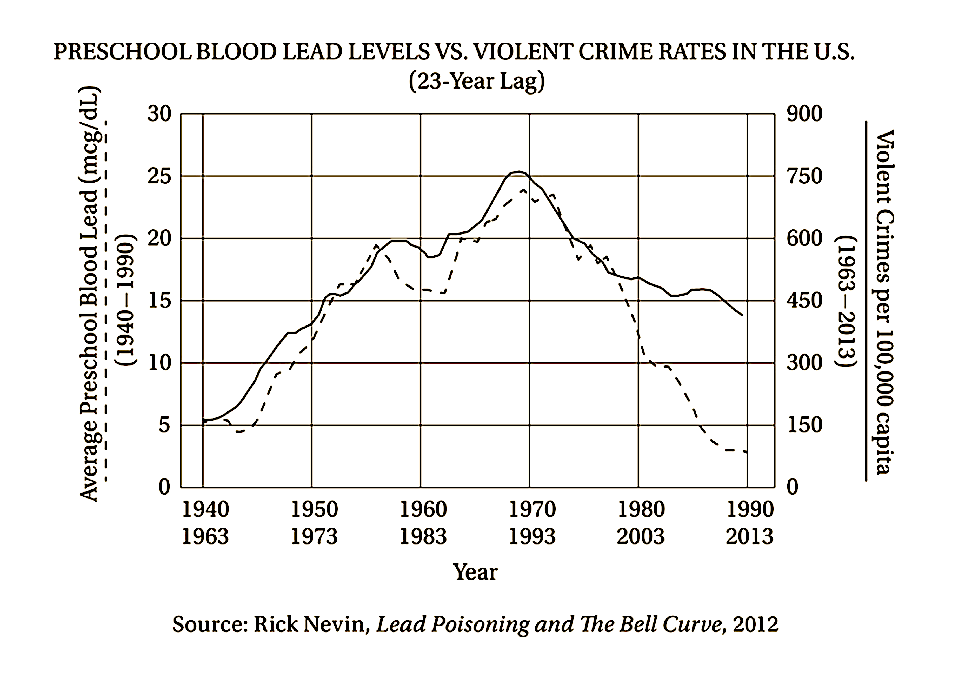
That tip took Nevin in a different direction. The biggest source of lead in the postwar era, it turns out, wasn’t paint, but leaded gasoline. If you chart the rise and fall of atmospheric lead caused by the rise and fall of leaded gasoline consumption, you get an upside-down U. Lead emissions from tailpipes rose steadily from the early '40s through the early '70s, nearly quadrupling over that period. Then, as unleaded gasoline began to replace leaded gasoline, emissions plummeted. Intriguingly, violent crime rates followed the same upside-down U pattern (see the graph). The only thing different was the time period. Crime rates rose dramatically in the '60s through the '80s, and then began dropping steadily starting in the early '90s. The two curves looked eerily identical, but were offset by about 20 years.
So Nevin dug up detailed data on lead emissions and crime rates to see if the similarity of the curves was as good as it seemed. It turned out to be even better. (II) In a 2000 paper he concluded that if you add a lag time of 23 years, lead emissions from automobiles explain 90 percent of the variation in violent crime in America. Toddlers who ingested high levels of lead in the '40s and '50s really were more likely to become violent criminals in the '60s, '70s, and '80s. And with that we have our molecule: tetraethyl lead, the gasoline additive invented by General Motors in the 1920s to prevent knocking and pinging in high-performance engines. As auto sales boomed after World War II, and drivers in powerful new cars increasingly asked service station attendants to "filler up with ethyl,” they were unwittingly creating a crime wave two decades later.
It was an exciting conjecture, and it prompted an immediate wave of... nothing. Nevin's paper was almost completely ignored, and in one sense it's easy to see why - (III) Nevin is an economist, not a criminologist, and his paper was published in Environmental Research, not a journal with a big readership in the criminology community. (IV) What's more, a single correlation between two curves isn't all that impressive, econometrically speaking. Sales of vinyl LPs rose in the postwar period too, and then declined in the '80s and '90s. No matter how good the fit, if you only have a single correlation it might just be a coincidence. You need to do something more to establish causality.
So in 2007, Nevin collected lead data and crime data for Australia, Canada, Great Britain, Finland, France, Italy, New Zealand and West Germany. Every time, the two curves fit each other astonishingly well. The gasoline lead hypothesis helps explain some things we might not have realized even needed explaining. For example, murder rates have always been higher in big cities than in towns and small cities. Nevin suggests that, because big cities have lots of cars in a small area, they also had high densities of atmospheric lead during the postwar era. But as lead levels in gasoline decreased, the differences between big and small cities largely went away. And guess 95 what? The difference in murder rates went away too. Today, homicide rates are similar in cities of all sizes. It may be that violent crime isn't an inevitable consequence of being a big city after all.
[question text="In the first paragraph, Karl Smith's work is presented primarily as " answers="a controversial sociological hypothesis.#a warning about potentially dangerous economic trends.#*a useful model for conceptualising a variety of phenomena.#a potential medical solution to a persistent social problem. "]
[question text="The author suggests that promising research in the social sciences is sometimes ignored because it " answers="*is not presented by authorities with the proper credentials#is not supported by controlled scientific experiments.#relies on complex mathematical calculations that are not easily understood.#uses historical data that are not necessarily valid in the modern era. "]
[question text="Which of the following provides the strongest evidence for the answer to the previous question? " answers="Lines I in Paragraph 2 (“A recent study . . . later on”)#Lines II in Paragraph 4 (“In a 2000 paper . . . America”)#*Lines III in Paragraph 5 (“Nevin is . . . community”)#Lines IV in Paragraph 5 (“What’s more . . . speaking”) "]
[question text="According to the graph for which of the following time periods was the percent increase in per capita violent crime the greatest? " answers="1940-1970#*1963-1993#1970-1990#1993-2013"]
[question text="According to the graph, which decade of violent crime statistics provides the LEAST support to Rick Nevin’s hypothesis? " answers="1963-1973#1980-1990#1983-1993#*2003-2013 "]
[question text="The author mentions 'sales of vinyl LPs' (Paragraph 5) primarily as an example of " answers="another economic factor that may explain a social trend.#how harmful chemicals can be spread via consumer products.#*a statistic that may be more coincidental than explanatory.#a counterintuitive trend in consumer behavior. "]
[question text="The 'complications' in Paragraph 2 are " answers="obstacles to gathering relevant data.#controversies about theoretical models.#challenges to the implementation of social policies.#*psychological problems. "]
[question text="The author regards the 'drivers' in Paragraph 4 as " answers="*inadvertent abettors.#unintentional heroes.#greedy consumers.#devious conspirators. "]
[question text="In Paragraph 4, 'even better' most nearly means " answers="less controversial.#*more correlative.#easier to calculate.#more aesthetically engaging. "]
[question text="The final paragraph serves primarily to " answers="suggest topics for future research.#concede a theoretical drawback.#propose a novel alternative.#*describe a supportive implication. "]
Questions 11-21 are based on the following passages.
Passage 1 is adapted from an essay written by John Aldridge in 1951. ©1951 by John Aldridge. Passage 2 is adapted from Brom Weber, “Ernest Hemingway’s Genteel Bullfight,” published in The American Novel and the Nineteen Twenties. ©1971 by Hodder Education.
Passage 1
By the time we were old enough to read Hemingway, he had become legendary. (A) Like Line Lord Byron a century earlier, he had learned to play himself, his own best hero, with superb conviction. (I) He was Hemingway of the rugged outdoor grin and the hairy chest posing beside a lion he had just shot. He was Tarzan Hemingway, crouching in the African bush with elephant gun at ready. He was War Correspondent Hemingway writing a play in the Hotel Florida in Madrid while thirty fascist shells crashed through the roof. Later, he was Task Force Hemingway swathed in ammunition belts and defending his post singlehandedly against fierce German attacks.
But even without the legend, the chest- beating, wisecracking pose that was later to seem so incredibly absurd, his impact upon us was tremendous. The feeling he gave us was one of immense expansiveness, freedom and, at the same time, absolute stability and control. We could follow him, imitate his cold detachment, through all the doubts and fears of adolescence and come out pure and untouched. (II) The words he put down seemed to us to have been carved from the living stone of life. They conveyed exactly the taste, smell and feel of experience as it was, as it might possibly be. (B) And so we began unconsciously to translate our own sensations into their terms and to impose on everything we did and felt the particular emotions they aroused in us. The Hemingway time was a good time to be young. (III) (C) We had much then that the war later forced out of us, something far greater than Hemingway’s strong formative influence.
(IV) Later writers who lost or got rid of Hemingway have been able to find nothing to put in his place. (D) They have rejected his time as untrue for them only to fail at finding themselves in their own time. Others, in their embarrassment at the hold he once had over them, have not profited by the lessons he had to teach, and still others were never touched by him at all. These last are perhaps the real unfortunates, for they have been denied access to a powerful tradition.
Passage 2
One wonders why Hemingway's greatest works now seem unable to evoke the same sense of a tottering world that in the 1920s established Ernest Hemingway's reputation. These novels should be speaking to us. Our social structure is as shaken, our philosophical despair as great, our everyday experience as unsatisfying. We have had more war than Hemingway ever dreamed of. (V) Our violence—physical, emotional, and intellectual—is not inferior to that of the 1920s. (VI) Yet Hemingway's great novels no longer seem to penetrate deeply the surface of existence. One begins to doubt that they ever did so significantly in the 1920s.
Hemingway's novels indulged the dominant genteel tradition in American culture while seeming to repudiate it. They yielded to the functionalist, technological aesthetic of the culture instead of resisting in the manner of Frank Lloyd Wright. Hemingway, in effect, became a dupe of his culture rather than its moral-aesthetic conscience. As a consequence, the import of his work has diminished. There is some evidence from his stylistic evolution that Hemingway himself must have felt as much, for Hemingway's famous stylistic economy frequently seems to conceal another kind of writer, with much richer rhetorical resources to hand. So, Death in the Afternoon (1932), Hemingway's bullfighting opus and his first book after A Farewell to Arms (1929), reveals great uneasiness over his earlier accomplishment. In it, he defends his literary method with a doctrine of ambiguity: "If a writer of prose knows enough about what he is writing about he may omit things that he knows and the reader, if the writer is writing truly enough, will have a feeling of those things as strongly as though the writer had stated them.”
(VII) Hemingway made much the same theoretical point in another way in Death in the Afternoon apparently believing that a formal reduction of aesthetic complexity was the only kind of design that had value. (VIII) Perhaps the greatest irony of Death in the Afternoon is its unmistakably baroque prose, which Hemingway himself embarrassedly admitted was "flowery." Reviewers, unable to challenge Hemingway's expertise in the art of bullfighting, noted that its style was "awkward, tortuous, [and] belligerently clumsy."
Death in the Afternoon is an extraordinarily self-indulgent, unruly, clownish, garrulous, and satiric book, with scrambled chronologies, 700 willful digressions, mock-scholarly apparatuses, fictional interludes, and scathing allusions. Its inflated style can hardly penetrate the facade, let alone deflate humanity.
11
[question text="On which topic do the authors of the two passages most strongly disagree? " answers="The economy of Hemingway’s writing#The incisiveness of Hemingway’s prose#The sincerity of Hemingway’s portrayals#The extent of Hemingway’s reputation "]
12
[question text="Which pair of sentences provides the strongest evidence for the answer to the previous question? " answers="Line I (“He was .. . just shot”) and Line VII (“Hemingway . . . had value”)#Line IV (“Later writers ... his place”) and Line V (“Our violence ... the 1920s”)#Line II (“The words . . . stone of life”) and Line VI (“Yet . . . existence”)#Line III (“We had much . . . influence”) and Line VIII (“Perhaps the greatest... was ‘flowery’”) "]
13
[question text="Which of the following best describes how each passage characterises Hemingway? " answers="Passage 1 portrays him as a tortured poet, but Passage 2 portrays him as a crass amateur.#Passage 1 portrays him as a master of refinement, but Passage 2 portrays him as a literary revolutionary.#Passage 1 portrays him as a hero, but Passage 2 portrays him as a cultural conformist.#Passage 1 portrays him as an absurd warmonger, but Passage 2 portrays him as an undisciplined artist. "]
14
[question text="Which statement about Hemingway is supported by both passages?" answers="He was an artistic pioneer, although he was underappreciated in his time.#He was a consistent practitioner of spare and evocative prose.#His characters serve as archetypes for masculine adventure.#His wartime narratives do not fully capture the horrors of war. "]
15
[question text="In Passage 1, the phrase 'living stone' most nearly means " answers="salient experience.#inevitable regret.#stubborn resistance.#durable memorial. "]
16
[question text="In Passage 1 lines 'And so we began unconsciously to translate our own sensations into their terms and to impose on everything we did and felt the particular emotions they aroused in us.' suggests that many of Hemingway’s readers were inclined to " answers="emulate his adventures.#resent his glorification of war.#imitate his literary style.#identify with his language. "]
17
[question text="The “lessons” mentioned in the last paragraph of Passage 1 most likely include stories of " answers="transformative romantic love.#confidence in the face of danger.#indulgent self-examination.#corporate or political ambition. "]
18
[question text="In the first sentence of Passage 2, the word 'tottering'' is intended to evoke a sense of " answers="infantile frailty.#economic instability.#artistic immaturity.#societal upheaval. "]
19
[question text="The author of Passage 1 would most likely regard the statement in the second paragraph of Passage 2 (“Hemingway, in effect . . . conscience”), with " answers="journalistic detachment.#grudging acquiescence.#vehement disagreement.#good-natured amusement. "]
20
[question text="Which statement provides the best evidence for the answer to the previous question? " answers="Lines A in Passage 1 (“Like Lord . . . superb conviction”)#Lines B in Passage 1 (“And so . . . aroused in us”)#Lines C in Passage 1 (“We had much . . . formative influence”)#Lines D in Passage 1 (“They have rejected ... own time”)"]
21
[question text="The author of Passage 2 suggests that, in comparison to Hemingway, Frank Lloyd Wright was relatively " answers="minimalist.#iconoclastic.#volatile.#traditional. "]
Questions 22-32 are based on the following passage.
This passage is from S. K. Mukherjee, “The Mysteries of the Strong Nuclear Force.” ©2015 College Hill Coaching.
As any good contractor will tell you, a sound structure requires stable materials. ( II ) But atoms, the building blocks of everything we know and love—bunnies, brownies, and best friends—don’t appear to be models of stability. Why are some atoms, like sodium, so hyperactive while others, like helium, are so aloof? Why do the electrons that inhabit atoms jump around so strangely, from one bizarrely shaped orbital to another? ( I ) And why do protons, the bits that give atoms their heft and personality, stick together at all?
( VI ) We are told that every atom has a tiny nucleus containing positively charged protons and uncharged neutrons, swarmed by a cloud of speedy electrons. We are also told that like charges, such as protons, repel each other with a force that shoots up to infinity as they get closer. ( III ) Even worse, you can't get much closer than two protons in the nucleus of an atom. So what's keeping atomic nuclei from flying apart? Obviously, some other force must be at work inside the atom, something that we can't detect at our human scale. Physicists call this the "strong nuclear force.” But where does it come from?
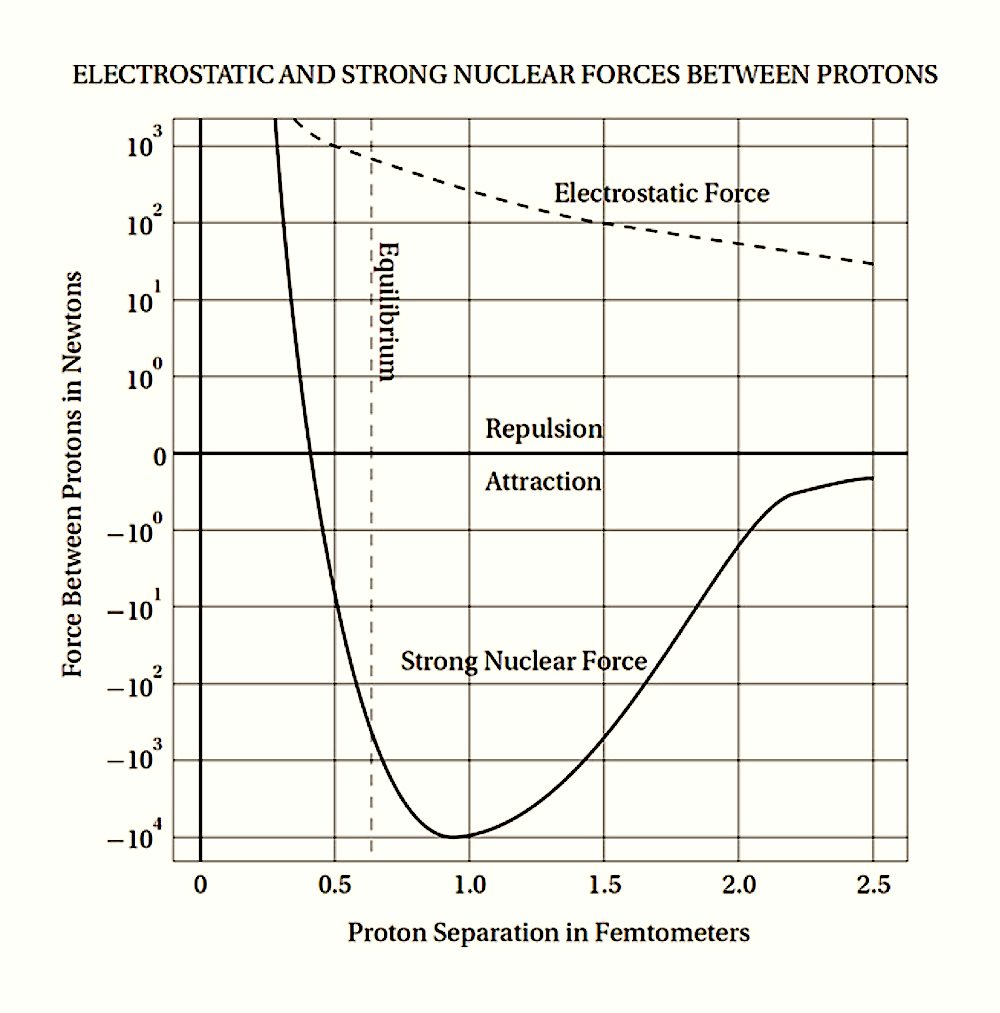
In order for this force to account for the binding of protons in the nucleus, it must have certain interesting features. First, it can’t have any sizeable effect beyond the radius of the atom itself, or it would play havoc with the nuclei of adjacent atoms, destroying matter as we know it. Second, it must perfectly balance the repulsive force of electricity at an “equilibrium point" of about $0.7 x 10^{-15}$ meters, the average distance between bound protons, in order to create a stable nucleus. Third, it must repel at even shorter distances, or else neutrons (which don't have any electrostatic repulsion to balance the strong nuclear force) would collapse into each other. The graph shows the behavior of such a force relative to the repulsive electrostatic force.
In 1935, Japanese physicist Hideki Yukawa proposed that the nuclear force was conveyed by a then-undiscovered heavy subatomic particle he called the pi meson (or "pion"), which (unlike the photon, which conveys the electrostatic force) decays very quickly and therefore conveys a powerful force only over a very short distance. Professor Yukawa's theory, however, was dealt a mortal blow by a series of experiments conducted at Los Alamos National Laboratory in the early 1990s that demonstrated that pions carry force only over distances greater than the 55 distance between bound protons. ( IV ) The pion was a plumber's wrench trying to do a tweezer's job.
Current atomic theory suggests that the strong nuclear force is most likely conveyed by massless particles called “gluons" according to the theory of quantum chromodynamics, or QCD for short. According to QCD, protons and neutrons are composed of smaller particles called quarks, which are held together by the aptly named gluons. This quark-binding force has a “residue" that extends beyond the protons and neutrons themselves to provide just enough force to bind the protons and neutrons together.
( V ) If you're hoping that QCD ties up atomic behavior with a tidy little bow, you may be just a bit disappointed. As a quantum theory, it conceives of space and time as tiny chunks that occasionally misbehave, rather than smooth predictable quantities, and its mathematical formulas are perhaps as hard to penetrate as the nucleus itself.
22
[question text="The primary purpose of the first paragraph (lines 1-12) is to " answers="describe a popular misconception.#introduce a physical theory.#suggest a scientific conundrum.#present a personal account. "]
23
[question text="In Paragraph 1, 'aloof' most nearly means " answers="impenetrable#formal.#retracted.#nonreactive. "]
24
[question text="The question ( I ) in Paragraph 1 (“And why ... at all?”) indicates " answers="a minor curiosity to scientists exploring deeper questions.#a socially significant puzzle that is unfortunately ignored in scientific circles.#a humorous irony in an other- wise serious field of investigation.#a central conundrum at the heart of an important scientific field. "]
25
[question text="Which sentence provides the best evidence for the answer to the previous question? " answers="Lines ( II ) in Paragraph 1 (“But atoms . . . stability”)#Lines III in Paragraph 2 (“Even worse . . . an atom”)#Lines IV in Paragraph 4 (“The pion . . . tweezer’s job”)#Lines V in Paragraph 6 (“If you’re . . . disappointed”) "]
26
[question text="In lines VI in Paragraph 2, the repetition of the phrase “We are” serves primarily to emphasize " answers="the predominance of certain conceptions.#the personal nature of scientific research.#the effectiveness of a particular analogy.#the deficiencies in public education. "]
27
[question text="In Paragraph 4, 'even better' most nearly means " answers="less controversial.#*more correlative.#easier to calculate.#more aesthetically engaging. "]
28
[question text="In Paragraph 4, 'even better' most nearly means " answers="less controversial.#*more correlative.#easier to calculate.#more aesthetically engaging. "]
29
[question text="In Paragraph 4, 'even better' most nearly means " answers="less controversial.#*more correlative.#easier to calculate.#more aesthetically engaging. "]
30
[question text="In Paragraph 4, 'even better' most nearly means " answers="less controversial.#*more correlative.#easier to calculate.#more aesthetically engaging. "]
|
|
Questions 1-10 are based on the following |
|
|
passage. |
|
|
|
|
|
This passage is adapted from Daniya! Mueenuddin, |
|
|
"Nawabdin Electrician." ©2009 by Daniyal Mueenuddin. |
|
|
|
|
|
Another man might have thrown up his |
|
|
hands—but not Nawabdin. His twelve daughters |
|
|
acted as a spur to his genius, and he looked with |
|
Line |
Line satisfaction in the mirror each morning at the face of |
|
5 |
a warrior going out to do battle. Nawab of course |
|
|
knew that he must proliferate his sources of |
|
|
revenue—the salary he received from K. K. Harouni |
|
|
for tending the tube wells would not even begin to |
|
|
suffice. He set up a little one-room flour mill, run off |
|
10 |
a condemned electric motor—condemned by him. |
|
|
|
|
|
He tried his hand at fish-farming in a little pond at |
|
|
the edge of his master’s fields. He bought broken |
|
|
radios, fixed them, and resold them. He did not |
|
|
demur even when asked to fix watches, though that |
|
15 |
enterprise did spectacularly badly, and in fact earned |
|
|
him more kicks than kudos, for no watch he took |
|
|
apart ever kept time again. |
|
|
|
|
|
K. K. Harouni rarely went to his farms, but lived |
|
|
mostly in Lahore. Whenever the old man visited, |
|
|
|
|
20 |
Nawab would place himself night and day at the door |
|
|
leading from the servants’ sitting area into the walled |
|
|
grove of ancient banyan trees where the old |
|
|
farmhouse stood. Grizzled, his peculiar aviator |
[end-block]
[end-test]
STOP
If you finish before time is called, you may check your work on this section only. Do not turn to any other section.