IELTS vs TOEFL: Which One Is Easier ?
- Super User
-
в Blog
-
Просмотров: 141
A practical comparison of Reading, Listening, Speaking, Writing, scoring, and preparation
Which test is objectively easier today, TOEFL of IELTS? Which one would you prefer ?
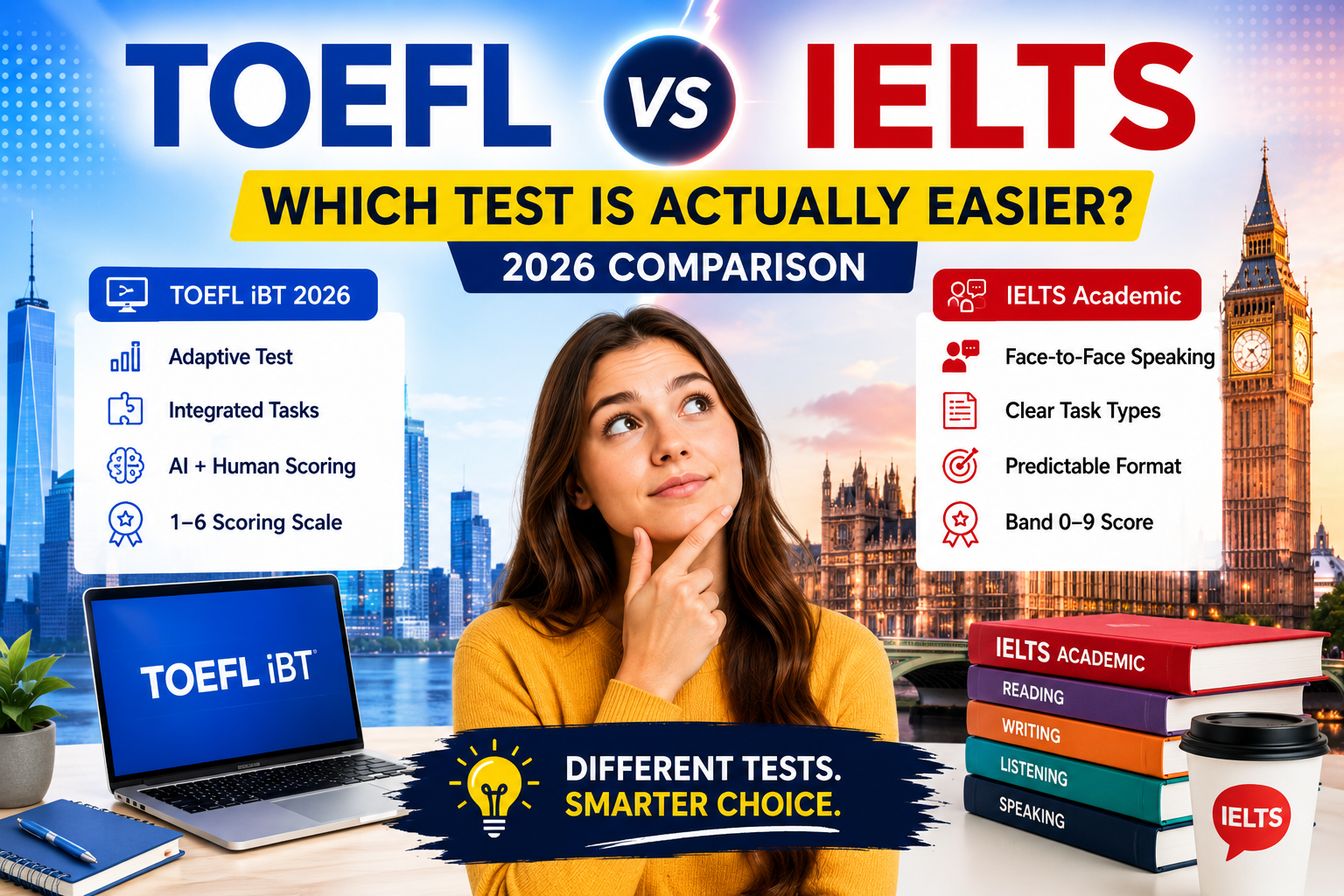
My short answer:
For most students, I would now choose IELTS as the easier test
But I would not say that IELTS is objectively easier in every section. It depends heavily on the candidate.
| IELTS Academic | TOEFL iBT 2026 | |
|---|---|---|
| Overall difficulty | ⭐⭐⭐ | ⭐⭐⭐⭐ |
| Reading | Usually easier | More demanding for some |
| Listening | Moderate | Moderate–hard |
| Speaking | Easier for most | Harder for many |
| Writing | Easier to prepare for | More unfamiliar format |
| Predictability | Very high | Lower because adaptive |
| Human interaction | Yes | No live examiner |
| Best for | General academic English, UK/Europe, many universities | Students comfortable with US-style academic testing/computer tasks |
Why I lean toward IELTS
1. Speaking is considerably more natural.
IELTS gives you an actual conversation with an examiner for 11–14 minutes. There are three predictable parts: familiar questions, a 2-minute long turn, and a deeper discussion.
For a student who can actually speak English, this is a huge advantage.
TOEFL speaking is much more test-like: you're producing responses under tightly controlled conditions, and the 2026 TOEFL uses a mixture of AI scoring and certified human raters.
So:
Good conversational English → IELTS advantage.
Good at structured computer-based tasks → TOEFL may suit you.
2. IELTS Writing is much more predictable
IELTS Academic Writing has two very clearly defined tasks:
- Task 1 — describe a graph/table/chart/diagram, minimum 150 words
- Task 2 — essay, minimum 250 words
Task 2 counts twice as much as Task 1.
That makes IELTS extremely coachable.
And this is particularly important for your students. If you're preparing someone from, say, B2 → IELTS 7.0, you can teach a relatively stable system:
Task → structure → paragraph function → language → common errors → practice.
TOEFL 2026 is less straightforward because the test is now adaptive and has redesigned task types.
3. IELTS Listening is more forgiving structurally
IELTS Listening has 40 questions, and the questions follow the order of information in the recording. You hear each recording once.
This creates a very exploitable strategy:
question → predict → listen → locate → answer.
TOEFL Listening requires more continuous comprehension of academic material and, depending on the task, synthesis and interpretation rather than simply locating information.
4. IELTS Reading is not necessarily easier
This is where I'd disagree with the simplistic claim that "IELTS is easier."
IELTS Academic Reading can be nasty at Band 7–8+.
You have 60 minutes for three passages and 40 questions, with a total text length of roughly 2,150–2,750 words.
And IELTS has some particularly unpleasant question types:
- True / False / Not Given
- Matching Headings
- Matching Information
- Sentence Completion
- Multiple Choice
For a student with excellent academic reading but weak test-taking technique, TOEFL can sometimes feel more straightforward.
The biggest change: TOEFL 2026
This is what makes the current comparison different.
Since January 21, 2026, TOEFL has:
- an adaptive test experience;
- redesigned content;
- a new 1–6 scoring scale in half-point increments;
- an overall score calculated from the four sections;
- a two-year transition during which a comparable 0–120 score is also reported.
So I would not use advice such as:
"TOEFL is easier because you can get 100 with X number of mistakes."
That's based on the old TOEFL and is increasingly obsolete.
If I were taking the test myself
I'd choose IELTS Academic.
Not because IELTS measures English better—it doesn't make sense to call one universally "better"—but because IELTS is more predictable and easier to optimise for a target score.
If my objective were:
"I need an English certificate with the least amount of preparation necessary."
I'd choose IELTS.
If my objective were:
"I'm an American-university-oriented student who is very comfortable with computers, academic lectures, rapid information processing and structured responses."
I'd seriously consider TOEFL.
My rough difficulty ranking
For an average strong B2/C1 candidate aiming for an equivalent of roughly IELTS 6.5–7.5:
IELTS:
Reading ⭐⭐⭐
Listening ⭐⭐⭐
Writing ⭐⭐⭐
Speaking ⭐⭐½
TOEFL 2026:
Reading ⭐⭐⭐½
Listening ⭐⭐⭐½
Writing ⭐⭐⭐½
Speaking ⭐⭐⭐⭐
The biggest practical difference, in my opinion, is Speaking + Writing.
And since I am teaching IELTS/TOEFL students, I think there's an even more interesting question: which exam gives a student the best chance of moving from B2 → C1 / IELTS 7.0–7.5 (or the TOEFL equivalent) with 2–3 months of preparation?
There I would choose IELTS quite decisively!
Ready to Get Your Target Score?
IELTS or TOEFL — the right preparation can make all the difference.
Whether you are aiming for a high IELTS / TOEFL score, or simply want to take the test with confidence, I can help you build a focused preparation strategy tailored to your current level and target score.
Personalised lessons • Proven strategies • Intensive exam practice • Individual feedback
Don’t just take the test. Prepare to succeed.
Interested in IELTS or TOEFL preparation? Get in touch and let’s discuss your target score and study plan.
I provide structured, personalized training that focuses on mastering each section of the exam.
My students gain all the necessary skills and confidence which help them successfully achieve their desired band scores, and progress to universities and careers abroad.
If you are committed to reaching your goals, I'd be very happy to guide you through your IELTS journey!
Please call +7 921 992 4690 or write to englishapple2000@gmail.com
Looking forward to hearing from you!